
Sri Lankan Leopard Habitat, Behaviour and Life in the Wild
Get to know Sri Lanka’s leopard through its habitat, solitary life and feeding behaviour, with a thoughtful introduction to watching wildlife in Kumana.
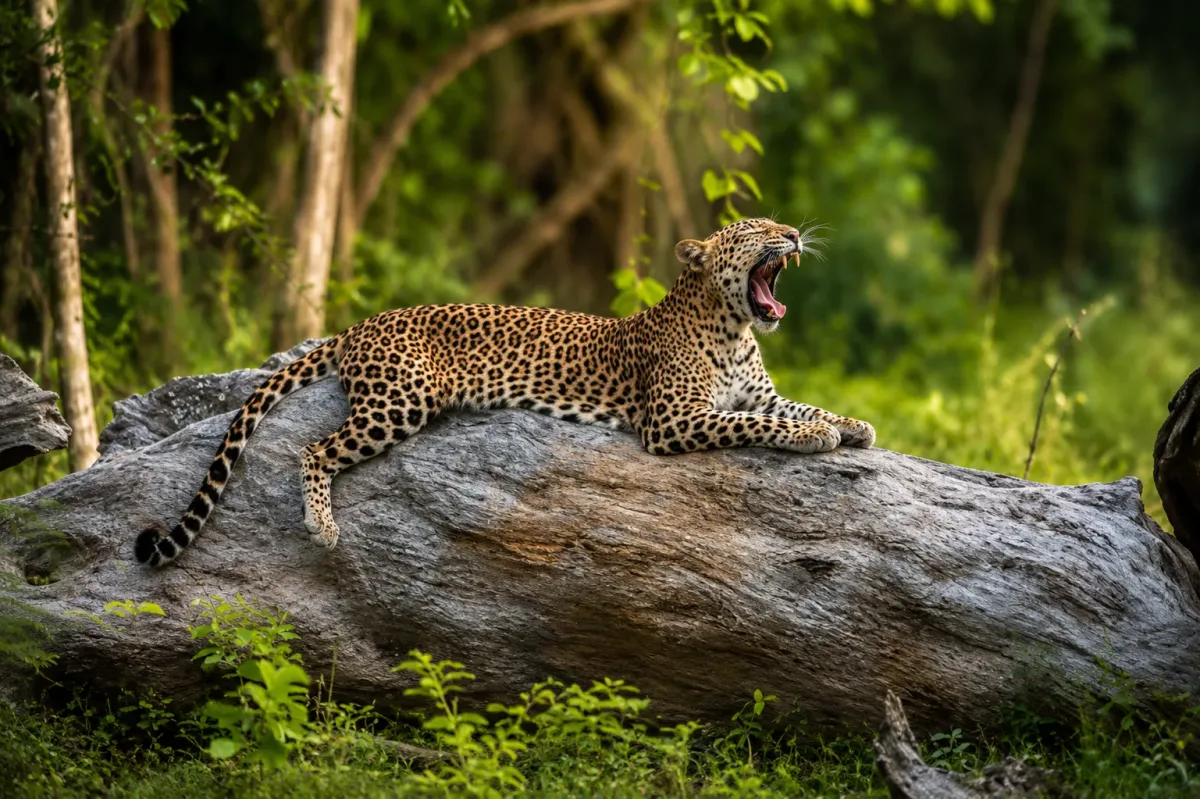
The Sri Lankan leopard, Panthera pardus kotiya, is the leopard subspecies native to Sri Lanka. Its life involves much more than the brief appearance a safari visitor might see: finding prey, using cover, resting and moving through a landscape that extends beyond the view from a jeep.
Learning a little about that life changes the way you watch. A leopard resting on a rock is worth observing without waiting for something dramatic to happen. The surrounding trees, shade and undergrowth are part of the encounter too.
What makes the Sri Lankan leopard distinctive?
The IUCN SSC Cat Specialist Group identifies the Sri Lankan leopard as Panthera pardus kotiya. Its spotted coat is familiar, but look closely and the markings become more interesting: individual leopards have different patterns.
Rather than trying to photograph only the face, notice the rosettes along the animal's flanks and the shape of its body against the background. A clear view of those details can be just as memorable as a close portrait.
Where do leopards live in Sri Lanka?
Their habitat is broader than a handful of well-known safari parks. The Wilderness and Wildlife Conservation Trust's research in the Peak Wilderness and Bogawantalawa area documents leopards using a highland landscape that includes forest patches, ridges and plantation surroundings. Those findings show why connections between areas of habitat matter.
In southeastern Sri Lanka, the Ministry of Environment's Kumana National Park profile includes leopards among the park's wildlife. It describes a landscape of forest, grassland, coastal vegetation and aquatic habitats. Kumana is therefore a place to experience a wider wildlife setting, with leopard sightings remaining a possibility rather than a promise.

How do leopards spend their time?
Solitary lives, with exceptions
Leopards are generally solitary and territorial. A female may be accompanied by dependent young, so seeing more than one does not contradict that general pattern. The Cat Specialist Group's behaviour overview also describes scent marking and vocal communication.
A visitor sees only a short part of an animal's day. Avoid assigning a family relationship or a particular intention to every group or movement you observe.
Resting is part of the story
A stationary leopard can be easy to overlook when you are searching for movement. Once your driver has identified an animal, take a moment to find its position in the landscape before reaching for your camera. Watch quietly and allow the view to develop on its own.
Leopards use different activity patterns in different environments; the Cat Specialist Group describes variation between populations. There is no dependable appointment time at which a wild leopard will appear beside a safari route.
What do Sri Lankan leopards eat?
They are carnivores. The Wilderness and Wildlife Conservation Trust's research summary from Yala National Park reports axis deer as the most common prey identified in its analysed samples, with black-naped hare also occurring frequently.
That is a finding from a particular study area, not a fixed menu for every leopard in Sri Lanka. It is a useful reminder that understanding a predator means paying attention to the other animals around it.
Leopards use cover and close approaches when hunting, as described in the species behaviour account. A patient observer can appreciate that relationship between animal and habitat without expecting to witness a hunt.
Why does leopard habitat need protection?
The Wilderness and Wildlife Conservation Trust's Leopard Project examines diet, range use and behaviour alongside pressures such as habitat depletion and poaching. Its work connects the study of individual animals with questions about the land they need.
For travellers, the practical lesson is to see more than a photograph waiting to happen. A leopard's value is not measured by how close it comes to a vehicle. Read our article on wildlife conservation and Sri Lanka's national parks for more about the wider landscape.

Watching for leopards during a Kumana safari
Tell the team if leopards are a particular interest, then leave space for the rest of the park. Birds, elephants, reptiles and the landscape can all give the outing a focus when a leopard stays out of sight. Our Kumana visitor guide introduces that broader setting.
The Sri Lanka Tourism Development Authority's safari guidelines call for following designated routes and giving animals right of way. Do not ask a driver to block a leopard's route or pursue it for a better angle.
Book Kumana Safari offers full-day and half-day Kumana safari options. Check the current package details and ask the team about arrangements for your visit.
Questions about Sri Lankan leopards
Is the Sri Lankan leopard a separate species?
It is recognised as a subspecies of leopard, Panthera pardus kotiya, rather than a separate species. The species name is Panthera pardus.
Can you see leopards in Kumana National Park?
Leopards are recorded among Kumana's wildlife, but a sighting cannot be guaranteed. Treat the safari as time in a wildlife landscape, not a reservation for a particular animal.
Do leopards always live alone?
They are generally solitary, with exceptions such as females accompanied by young. A brief sighting or a photograph may not reveal the relationship between the animals.
Does a full-day safari guarantee a leopard sighting?
No. Choose the outing that suits the time you want to spend exploring. A longer booking does not turn a wild animal's movements into a guarantee.


